japonisme

14 April 2012

THE DELIGHT SONG OF TSOAI-TALEE


I am a feather on the bright sky
I am the blue horse that runs in the plain
I am the fish that rolls, shining, in the water
I am the shadow that follows a child
I am the evening light, the lustre of meadows
I am an eagle playing with the wind


I am a cluster of bright beads
I am the farthest star
I am the cold of dawn
I am the roaring of the rain
I am the glitter on the crust of the snow
I am the long track of the moon in a lake


I am a flame of four colors
I am a deer standing away in the dusk
I am a field of sumac and the pomme blanche
I am an angle of geese in the winter sky
I am the hunger of a young wolf
I am the whole dream of these things


You see, I am alive, I am alive
I stand in good relation to the earth
I stand in good relation to the gods
I stand in good relation to all that is beautiful
I stand in good relation to the daughter of Tsen-tainte
You see, I am alive, I am alive

N. Scott Momaday

from In the Presence of the Sun: Stories and Poems, 1961-1991. Copyright ©1991 by N. Scott Momaday

Labels: , , , , , , , , , ,

01 January 2012

1112 (sounds almost like beethoven)

24 November 2011

to the young people & the union members & the old people & the vets & etc who crack nuts & who i hope i might have been one had this been then

FABLE

The mountain and the squirrel
Had a quarrel;
And the former called the latter ‘Little Prig.’


Bun replied,
‘You are doubtless very big;
But all sorts of things
and weather
Must be taken in together,

To make up a year
And a sphere.
And I think it no disgrace
To occupy my place.


If I'm not so large as you,
You are not so small as I,
And not half so spry.


I'll not deny you make
A very pretty squirrel track;


Talents differ; all is well and wisely put;
If I cannot carry forests on my back,
Neither can you crack a nut.’

Ralph Waldo Emerson

Labels: , , , , , , ,

23 September 2011

A Crown of Autumn Leaves


Our voices press

from us
and twine
around the year's
fermenting wine


Yellow fall roars
Over the ground.
Loud, in the leafy sun that pours
Liquid through doors,
Yellow, the leaves twist down

as the winding
of the vine
pulls our curling
voices—

Glowing in wind and change,
The orange leaf tells

How one more season will alter and range,
Working the strange
Colors of clamor and bells

In the winding
of the vine
our voices press out
from us
to twine

When autumn gathers, the tree
That the leaves sang
Reddens dark slowly, then,
suddenly free,

Turns like a key,
Opening air where they hang

and the winding
of the vine
makes our voices
turn and wind
with the year’s
fermented wine

One of the hanging leaves,
Deeply maroon,
Tightens its final hold, receives,
Finally weaves
Through, and is covered soon
in the winding
of the vine—

Holding past summer's hold,
Open and strong,
One of the leaves in the crown is gold,
Set in the cold
Where the old seasons belong.


Here is my crown
Of winding vine,
Of leaves that dropped,
That fingers twined,
another crown
to yield and shine
with a year’s
fermented wine.

Annie Finch

For Mabon (fall equinox), Sept. 21
copyright Annie Finch 2011

Labels: , , , , , , , ,

03 September 2011

Of Woodblocks and Puppets

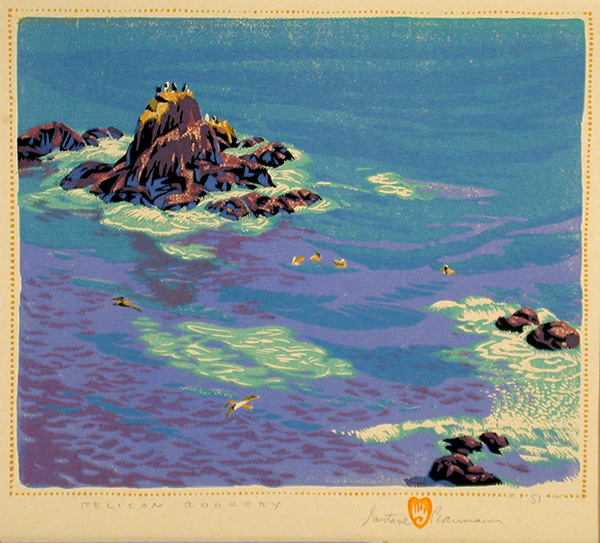
German-born Gustave Baumann found his way to Brown County [Indiana] in the early part of the 20th century via the Art Institute
of Chicago and a return to Germany. After studying printmaking in both locales, Baumann set up a press in a vacant store in Nashville and
there perfected his skills.

A trip into Brown County to investigate art possibilities led the artist to tell a biographer that "Brown County was easy to commute to, and I found that restful something we all yearn for. Life was simple. I could stay two months for $100."Baumann leased or rented the rooms over Genolin's drug store—four rooms for $4 a month.

During his time in Brown County, Baumann was commissioned by Indianapolis based children's poet James Whitcomb Riley to create
12 illustrations for his book, "All the Year Round." "I did the book,
but not knowing the rules of the game, it turned out to be a Baumann book with Riley text. It consequently was a dismal flop," Baumann
told a biographer.

"I liked the place," Baumann said. "Someone has said that literature and art flourish wherever people give themselves time to think. Indiana was one of those places. The artist was accepted with amused tolerance. As such, he could move around freely without being exploited as a strange creature who radiated publicity value. But art is a kind of tyrant. It pushes you around. It came to me dressed up in wanderlust."

The same wanderlust that brought the printmaker to Brown County
is the same wanderlust that took him away. He once wrote, "Instead
of being tied to a musty museum, the artist likes to herd in colonies where life and landscape are a source of inspiration. There are
many of these all over the United States. Some of them have worn themselves out. Of those that persist, Provincetown, Brown County, Indiana, Taos, New Mexico, and Laguna Beach, California, are perhaps the best known."

It was New Mexico that lured him from Brown County. The Baumann's home in Santa Fe became a meeting place for all kinds of poets and writers. "In fact, the whole artistic community met there," said one
of their friends. "Jane had a sort of open house tea every single day,
and anyone who wanted to could come and join. She was a wonderful cook and baker."

Baumann had started making marionettes around 1930 for a change from prints and oil painting. "He never worked them, though," said his daughter Ann. "He couldn't coordinate speaking and manipulating them. Mother could and he advised." Over time the collection of carved wooden marionettes grew to about 60, with three modeled after Ann, Jane and Gustave himself. And the family and their friends began putting on puppet shows in the Baumanns' living room. They also took the show to various schools, to Colorado, and to Albuquerque.

The artist's talented work in the wood for blocks for his prints carried over into his marionettes, leading one of his New Mexico friends to say, "They're remarkable things, just as artistic as his wood blocks. He loved working in wood, was a master carver, and this is where he put his creativity. They [the marionettes] brought an awful lot of enjoyment
to a lot of people."

Joanne Nesbit
Our Brown County

see more of these wonderful marionettes
Labels: , ,

10 August 2011

beauty


how strong is beauty. it will utterly transport you. it will teach you lessons about being still. sometimes you can even fear its power, its power to turn you into someone else, its power to change you forever. but whatever your fear, you have no choice in the matter. if it is too frightening, you can look away, but the power of beauty to change you is the gift your soul desires.

Labels: , , , , , ,

26 June 2011

released

RELEASE

With rod and tackle box,
I'm slogging through soft sand,

a red sun going down in the surf,
swag-belly clouds drifting in

with Ray, only two months dead,
going on about girls that summer

we studied French in Québec and
guzzled Labatts at the Chien d'Or,

about how he'll marry again, keep
at it until he gets it right—
Pas vrai
?

Above the tide wrack, a woman
in a two-piece with half my years

kneels struggling in the sand
with a pillow of feathers,

one wing flapping—a pelican
tangled in fish line, treble hook

in the bill pouch,
the other in its wing.
Ray says, Ask her out for a drink

but she says,
Could you give me a hand?
I drop the tackle and secure the wing

while she croons to calm him and
with one free hand
untangles the line.

With pliers from the tackle box,
I expose the barbs and carefully clip,

a total of six loud snaps.
Then I hold
the bird while she frees
the last tangle

and we step back,
join the onlookers,
a father explaining care to his kids.

The pelican now tests his wings, rowing
in place. He looks around and seems

to enjoy the attention, just as Ray did
in bars, buying drinks and telling jokes.

But this college boy with a can of Bud
is no joke and says they watched it flap


all afternoon
from that deck on the dune.
His buddy agrees with a belch

that buys a round
of frat boy laughter.
Ray tells me the kid needs his clock cleaned

just when the pelican waddles up
and puts his soft webbed foot on mine.

He tilts his head to
catch my look, then
flapping runs into the air,
tucks his feet,


and climbs, turning over our small circle,
before heading west. Dazzled and dumb,

I'm faintly aware of the woman,
then gone,
weightless and soaring over water, looking

down on myself slogging through sand,
certain that I'm being watched,


if only by another self
who will have to tell how it happened.

Peter Makuck

From Long Lens by Peter Makuck. Copyright © 2010 by Peter Makuck.

Labels: , , , , , , , , ,

23 June 2011

second hand rose

simultaneous with ukiyo-e, was chiyogami, printed with woodblocks, just like the prints.


one story has it that the prints were "discovered" as they were used as wrapping paper; chiyogami was created as wrapping paper!


considered as decorative rather than narrative, the collections and comments are far rarer than are those for ukiyo-e. i'll recommend some great books; if you want the whole story, it really is all over the internet.


it was used for bookbinding and toy-making as well as for wrapping gifts. when i first saw chiyogami, i felt aha! i have found the missing link.

but researching this post, at this moment in my life (of which there is always one), has opened up in me more questions than i would ever answer.

and i ask, should i always want to? the brain may wonder, and allow that to be it. does everyone have to be a scholar?

perhaps i will list some of the questions: why is all of the western design i see so orderly? do the japanese prints seem orderly to the japanese?

why do color combinations and print pairings seem so often off-kilter to my eyes; we would never wear that print with that one. see all the kimono prints. do the japanese see the west as having an odd sense of color and coordination in a look?

what about the wiener werkstatte allowed more chaos in design than other western styles of the time? why do a blog? to look things up in wikipedia or books? to parrot informative information?

why have we insisted upon answers and orderliness? have we understood anything about the japanese at all? stop thinking.

just.


stop.

Labels: , , , , , , ,

22 April 2011

falls apart in the perfume


THE LEMON TREES


Hear me a moment. Laureate poets
seem to wander among plants
no one knows: boxwood, acanthus,
where nothing is alive to touch.

I prefer small streets that falter
into grassy ditches where a boy,
searching in the sinking puddles,
might capture a struggling eel.

The little path that winds down
along the slope plunges
through cane-tufts
and opens suddenly
into the orchard
among the moss-green trunks
of the lemon trees.

Perhaps it is better
if the jubilee of small birds
dies down, swallowed in the sky,
yet more real to one who listens,
the murmur of tender leaves
in a breathless, unmoving air.

The senses are graced with an odor
filled with the earth.
It is like rain in a troubled breast,
sweet as an air that arrives
too suddenly and vanishes.


A miracle is hushed; all passions
are swept aside. Even the poor
know that richness,
the fragrance of the lemon trees.

You realize that in silences
things yield and almost betray
their ultimate secrets.

At times, one half expects
to discover an error in Nature,
the still point of reality,
the missing link
that will not hold,
the thread we cannot untangle
in order to get at the truth.

You look around. Your mind seeks,
makes harmonies, falls apart
in the perfume, expands
when the day wearies away.
There are silences in which one watches
in every fading human shadow
something divine let go.


The illusion wanes,
and in time we return
to our noisy cities where the blue
appears only in fragments
high up
among the towering shapes.
Then rain leaching the earth.
Tedious,
winter burdens the roofs,
and light is a miser, the soul bitter.

Yet, one day
through an open gate,
among the green luxuriance
of a yard,
the yellow lemons fire
and the heart melts,
and golden songs pour
into the breast
from the raised cornets of the sun.

Eugenio Montale

translated by Lee Gerlach

Copyright © 2002, 2004 Harry Thomas, Handsel Books (an imprint of Other Press LLC).

Labels: , , , , , , , , , , ,

older posts